The shockingly brazen Louvre heist has brought art security to the forefront of international attention. Could a Mayfair institution be next?
Words: Will Moffitt
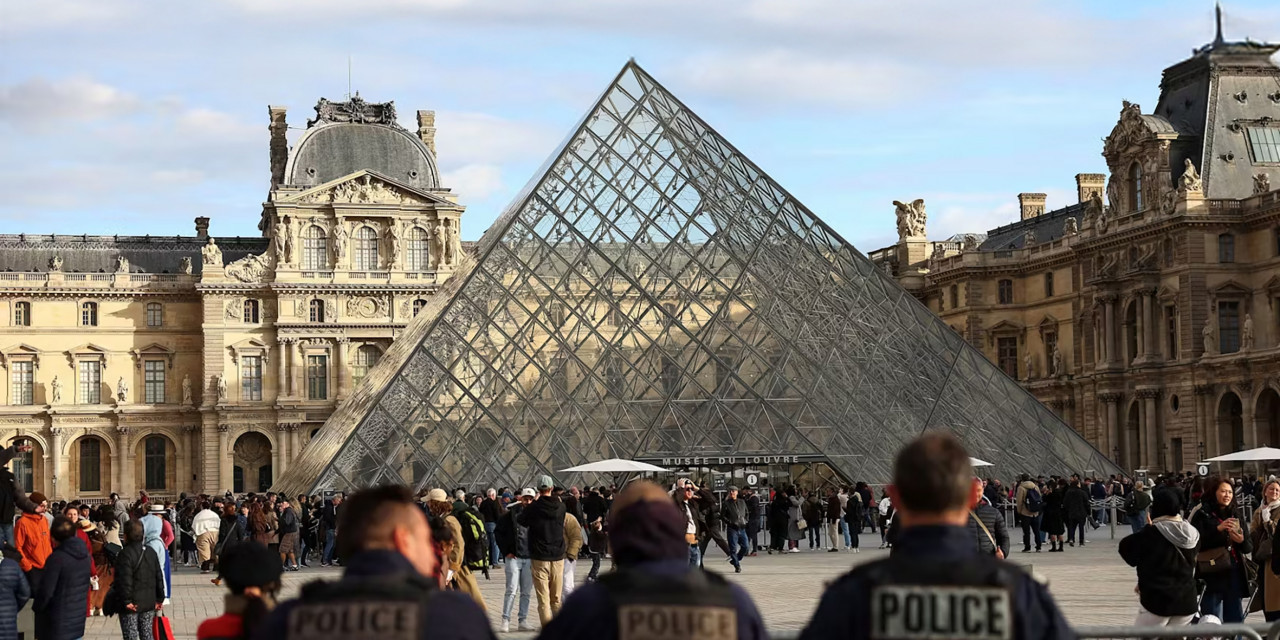
Is it the crime of the century? C’est très possible. Given the global attention it has garnered, there’s little point in revisiting the Louvre heist in much detail here. The salient facts are these: at 9.30am on October 19, a gang of thieves disguised as construction workers scaled the first-storey balcony of the Louvre using a furniture lift and cut though the glass window with a disc cutter, threatened guards with power tools and left with an estimated €88 million (£77 million) worth of crown jewels.
In roughly the time it takes most of us to have our morning shower, the smash and grab was complete. It wasn’t perfect, either: in their haste the thieves fumbled Empress Eugénie’s crown, leaving it bashed up on the street. “The jewels will be found,” French president Emmanuel Macron declared with feigned authority.
At the time of writing French authorities have four suspects in custody. The precious loot, however, is unrecovered, its whereabouts unknown.
It may be appealing to call it a French omnishambles or to laugh at all the memes, but the lessons from the Louvre are sweeping. Even if the jewels are reclaimed, the safety and security of almost every European cultural institution has been called into question.
“There is a trend going on throughout Europe where museums are being hit for gold and jewellery,” art recovery specialist Christopher Marinello says. “Instead of being stolen and sold in the marketplace intact, it’s being melted down, or the jewels are being broken up and sold for the raw material, which is in itself very valuable.” A lawyer by trade, Marinello, who is in his early 6os, has spent 30 years tracking down stolen masterpieces.


Art Recovery International, the company he founded in 2013, very much does what it says on the tin. Increasingly he has plied his trade in recovering stolen luxury goods, many of them swiped in Mayfair. This surge of criminals plundering cultural treasures purely for the value of their raw materials is, according to Marinello, a relatively novel phenomenon and “quite a drastic change” from yesteryear, when balaclava-clad thieves were running off with Picassos.
Marinello first noticed a potential trend developing in 2017, when a giant gold Canadian coin bearing Elizabeth II’s image was stolen from the Bode-Museum in Berlin. Comprising 220lb of pure gold, it was deemed to be worth £3.4 million. It has never been found. Years of austerity and limited funding have left many cultural institutions short on cash for improved security measures. In challenging times, many opt to spend most of their budgets on exhibitions and public programming. Compounding the issue has been the slashing of public spending on the police and the criminal justice system.
“I get calls all the time from police officers who say: ‘Chris, we just can’t investigate all these thefts,” Marinello says. “They tell me: I’m sorry, there’s nothing we could do. We’re so frustrated because the prosecutors don’t prosecute, even if we spend a lot of time on a case. If they don’t prosecute the criminal, what’s the point?'”
“The smash and grab type theft is very hard to protect against, even if you’ve got state-of-the-art security,” Marinello adds. “I could walk into the British Museum right now with a sledgehammer and probably come out with something.” Indeed, the British Museum was another institution that made the headlines when, in 2023, news broke that about 2,000 artefacts from the museum, primarily from its Greek and Roman collection, had gone missing. Nobody has been charged over the disappearance.
Several prominent galleries in Mayfair and St James’s, including the Royal Academy, declined to comment for this piece, stating that it was not their policy to discuss security matters. Understandably these institutions will be on red alert, scouring out copycat criminals. Arthur Brand, a Dutch art detective who has recovered hundreds of stolen and missing artworks, including pieces by Picasso and Dalí, believes the Louvre case may have been inspired by another heist. “These guys were probably copycats too, because a month before the Louvre [heist], there was a heist in the [Paris] Natural History Museum where gold nuggets were stolen,” he says.
Brand has tracked down stolen paintings and antiquities around the world. In the case of the Divan of Hafez, a plundered 15th-century Iranian manuscript, he worked with a Mayfair dealer to recover it. He is mostly sympathetic to art galleries and cultural institutions, arguing that they have to walk a tightrope, delivering accessibility and flawless security. Turning these frequently old and hulking buildings into Fort Knox risks alienating visitors. Sometimes, just like in the movies, the criminals are just too damn smart. These days if Brand receives a tipoff regarding a stolen item he just prays that it’s not gold or jewellery. “I always hope that they steal a painting,” he says, “because they won’t cut it in two.”